https://livingchurch.org/news/news-episcopal-church/for-alabama-bishop-elect-new-call-is-a-homecoming/
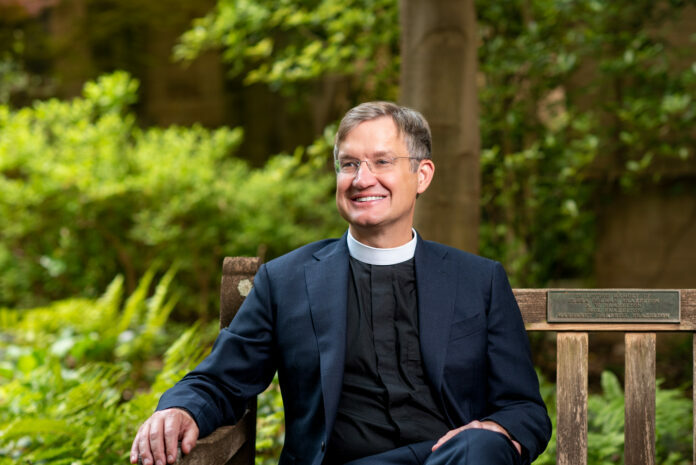
Caleb Maglaya Galaraga for Living Church Magazine
A 2024 census shows that the population of the city of Guntersville in north Alabama is just below 9,000. The Very Rev. Richard Lawson III’s experience at a United Methodist Church in the small city defined the course of his personal life and ministry.
Following his ordination to the diaconate in the Diocese of Alabama in 2001, he served as curate, then rector, at St. John’s Church in Decatur for almost a decade. Most recently, he was the dean of the Cathedral of St. John in Denver, Colorado.
On January 31, Lawson was elected on the first ballot as the 13th Bishop of Alabama and will be consecrated at the Cathedral Church of the Advent in Birmingham, 75 miles from where he grew up, on June 27 by Presiding Bishop Sean Rowe.
Reflecting about his ministry, he recalls his time attending the Sunday School of the United Methodist Church in his hometown, which had a total attendance of two students: him and his best friend. “The benefit of what God gave that little United Methodist Church was the ability to really take care of two people,” Lawson told The Living Church.
He was in elementary school when they gave him a Bible. “It was one of those Bibles…when you turn to the New Testament and you turn to the four Gospels, all of Jesus’ words are written in red. And the red just explodes off the page.” That red-letter version of Scripture continues to have an impact on the bishop-elect.
“Beginning from when I was a child all the way through now, I always felt like the words of Jesus, the stories of Jesus, the teachings of Jesus have this fire and are directed personally to me and to everyone,” Lawson told TLC. Because of how the words were printed, he had always “felt Jesus speaking to me personally in and through the four Gospels,” and described it as having a “vivid sense of our Lord’s presence.”
It was at Auburn University while completing his bachelor’s degree in religion that a woman he was dating, Katherine, suggested he attend an Episcopal parish.
He began worshiping at St. Dunstan’s Church, right on campus at Magnolia Avenue. As he told the people of the diocese during the bishop search process: “It was [at St. Dunstan’s] that I fell in love with Christ’s presence in the sacraments. I fell in love with a God who was bigger and more mysterious and loving and interesting than I’d ever been told before. I also fell in love with the three-legged stool of Anglicanism—scripture, tradition, and reason.”
Lawson was confirmed Episcopalian in that parish and almost immediately, after witnessing two priests “preach a lovely homily [and] celebrate the sacraments with grace and reverence,” he felt a call to the priesthood.
One of those priests is the late Rev. John Cruse, who had a significant influence in his life, especially while Lawson was a seminarian at the General Theological Seminary in New York, where he received his Master of Divinity in 2001.
At Auburn, Lawson would not only fall in love with the church and the Anglican faith; Cruse celebrated his wedding with Katherine, a native of Birmingham and a cradle Episcopalian, 28 years ago.
The Alabama native will succeed Bishop Glenda Curry, who was consecrated as bishop coadjutor in June 2020 and as bishop diocesan in January 2021. Curry describes her successor as “extremely qualified” and “gifted to lead our great diocese into our next chapter.” The diocese consists of 86 parishes and eight college ministries serving nearly 30,000 Episcopalians.
Lawson believes there is a hunger in his home state for a sacramental experience of worship that’s grounded in the gospel. He said he will be committed to encouraging the clergy of the diocese to preach the Gospel “in a way that builds up the body and helps the gospel relate to our own personal stories for people who come to our churches.”
He believes that good storytelling and strong interpretation of Scripture will be vital in accomplishing that goal in terms of Gospel proclamation.
Lawson is cognizant of today’s political tensions and the historic significance of not only the diocese he leads, but the city where he will be consecrated. In this regard, he said he will build on Curry’s work, who has appointed a missioner for racial healing and pilgrimage that works with congregations in their journey for racial reconciliation.
“And in Montgomery, I visited the National Memorial for Peace and Justice, which is the nation’s first comprehensive memorial dedicated to the legacy of Black Americans who were lynched.”
“I look forward to partnering in any way I can with the spirit’s work that calls us to racial healing.”
His daily prayer as he prepares for this new call, which will bring him nearer to his family and familiar places, is reflected in one of the key responses in the Baptismal Covenant, which every confirmand utters, and every Episcopalian regularly reaffirms: “With God’s help.”