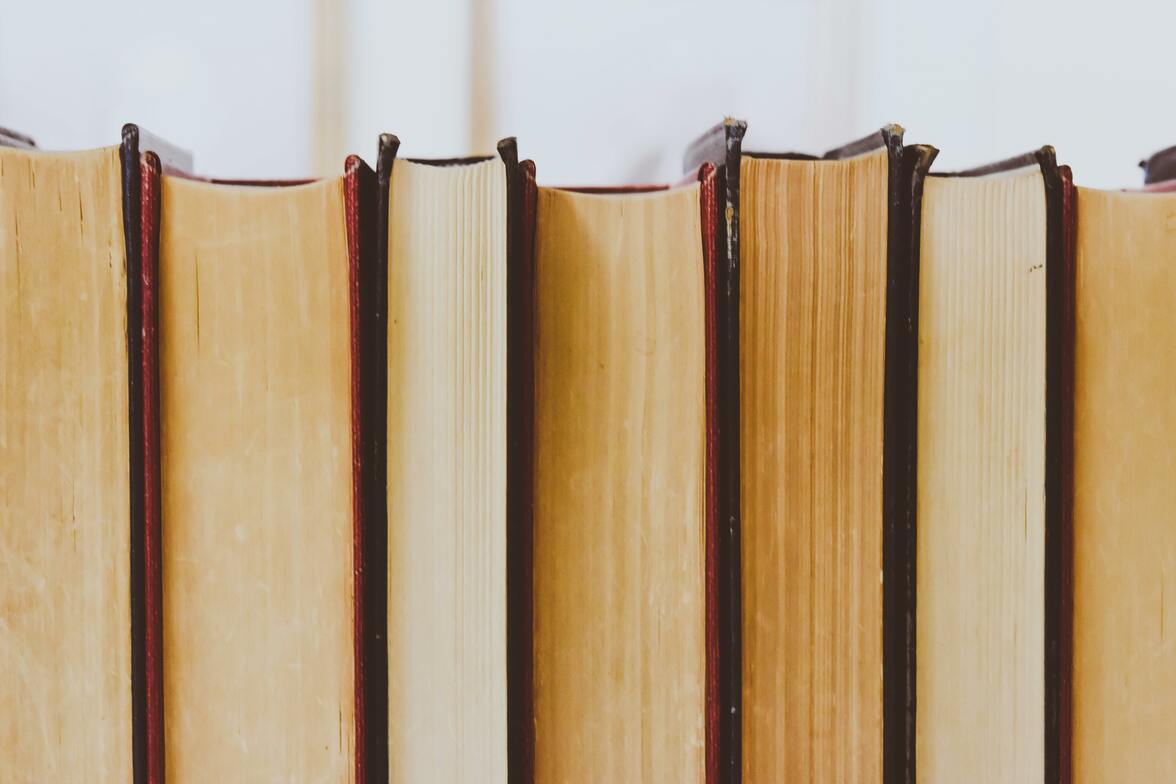
I once had a weird friend. Actually, that is unfair. Let me rephrase it. I once had a friend who did weird things. That’s better. He had one habit in particular that, to my eyes, was so ‘unconventional’ that I really worried about his stability. I’ll call him Hamish. That’s not his real name but I think ‘Hamish’ is much under-appreciated, so I’ll use it.
Hamish’s main weirdness was that he covered all his books in brown paper. I remember having to do this at school. At the beginning of the academic year we were issued with a new textbook and our first assignment was to go home and cover it with brown paper, thereby preserving its pristine condition in the face of the nine months of vandalism that we would unleash upon it. We had to do this to all our textbooks.
The problem with Hamish, though, was that we were no longer at school. I met Hamish when he was 40 years old, a professional, and a man of great taste. And he had lots of books. I couldn’t believe his shelves the first time I went to his home. Hundreds of books – all covered in brown paper and all looking the same.
Why would anyone do this? If you wanted to start that new Harlen Coben novel, you’d want to be able to quickly spot it on the shelves, wouldn’t you? But not my friend. He seemed to enjoy the challenge of rooting through hundreds of volumes that all look the same until he found the one he was looking for. What’s more, he didn’t even write the titles on the brown paper covers. So, to discover the title of the book you had to take it off the shelf and open it. This is one of the strangest things I’ve ever seen.
When Hamish reached for a book, how did he know if he was getting a murder-mystery, a witty biography, or a volume about bird-watching? When every book is covered with brown paper, how do you know if you’re holding good news or bad news when you lift it from the shelf?
In an old Chinese story, a farmer buys a horse to help him plough. “That’s good news”, his neighbor tells him. The farmer replies, "Good news or bad news, who can say?"
A week later the horse runs away. His neighbor says, "That's bad news."
The farmer replies, "Good news or bad news, who can say?"
A week after that the horse returns and brings along another horse. “Good news”, says the neighbor.
The farmer replies, "Who can say?"
The farmer gives the second horse to his son, but the horse throws him and he badly breaks his leg.
The concerned neighbor goes next door and says, "I’m so sorry for your bad news," "Good news, bad news, who can say?" the farmer replies.
The next day, the emperor declares war with a neighboring country, and officials go throughout the land, taking every able-bodied young man to fight. The farmer's son is spared.
Life is like a library where all the books are covered with brown paper. You just can’t tell what you’re getting. Is this event ‘good’ or ‘bad’? Who knows? Sometimes it can be many years after the book is over that you look back and see that it was a good news story all the time, and you had not realized it.
Maybe Hamish was onto something. Maybe his ‘thousand books that all look the same’ freed him to take each one as it came and read it without having to label or define it. Maybe before we judge the events that happen as good or bad we should remember the amazing power of God to take the very worst situation and turn it into beauty.